
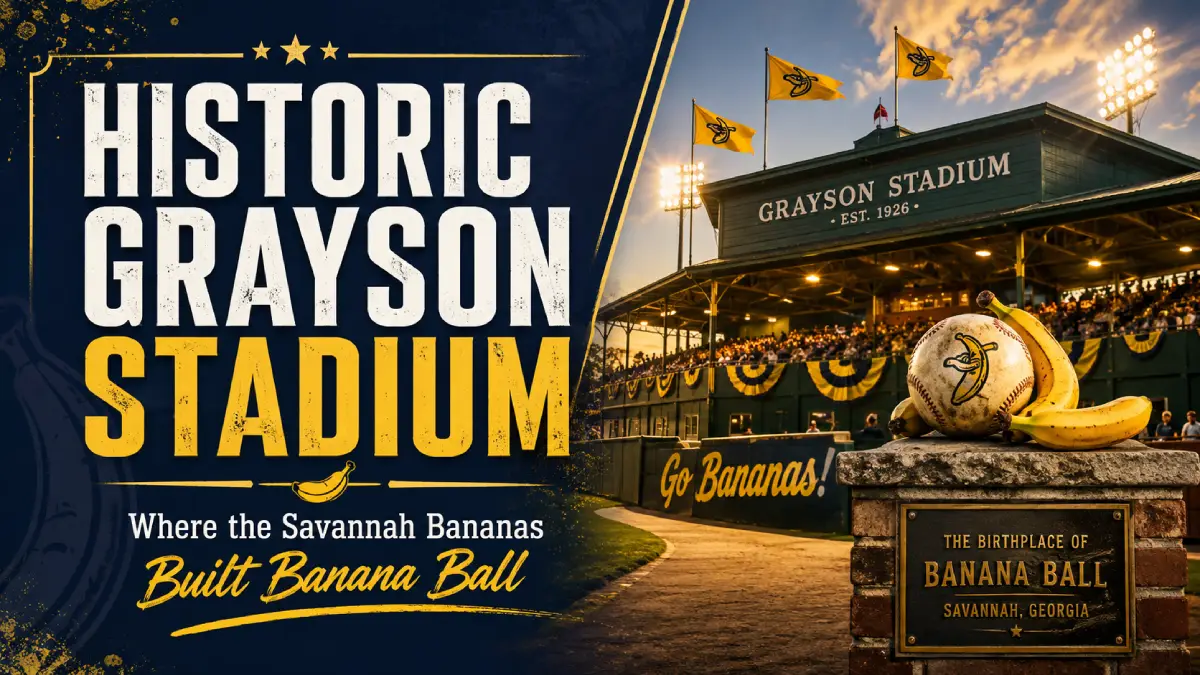
Historic Grayson Stadium matters to Banana Ball because it gives a national touring sport a real origin point. The Savannah Bananas now play in huge venues around the country, the BBCL has six professional teams, and 2026 includes MLB stadiums and major national broadcasts. But the organization’s modern story still begins with a much smaller problem in Savannah: how do you make people care about baseball at Grayson Stadium after affiliated minor-league baseball has left the city?
The Savannah Bananas’ official history says the organization arrived in October 2015 as a college summer team. Ticket sales were initially poor, the owners overdrafted their bank account and sold their home to keep the project alive. The name “Savannah Bananas” was announced February 25, 2016, drawing national attention and helping lead to a sold-out Opening Night.
Grayson was the laboratory for Fans First
The first sellout was not presented as a conventional baseball night. The official team history describes all-inclusive food, the Banana Nanas senior dance team, the first Banana Baby and dancing players. Those ideas established a pattern: the ticket should deliver an experience that is memorable even if the fan does not know the roster.
Over time, the organization added and refined characters, walk-ups, dances, celebrations and eventually Banana Ball rules. Grayson was the place where those ideas could be repeated in front of a home crowd and improved night after night.
The stadium gives the brand credibility that a viral clip cannot
Online popularity can make a sports property look as if it appeared overnight. A physical home tells a longer story. Fans can point to a stadium, a city and an Opening Night rather than treating Banana Ball as a social account that later decided to sell tickets.
That history is one reason the national tour does not erase Savannah. The place is part of the product’s identity even when the largest crowds happen elsewhere.
Why an old ballpark fits a deliberately modern sports experience
There is an obvious contrast between a historic baseball stadium and a format built around fast games, choreography, short-form video and constant crowd engagement. That contrast helps rather than hurts. Banana Ball can show that it is changing the experience of baseball without needing a futuristic building to do it.
The same principle applies when the tour enters Yankee Stadium or Wrigley Field: familiar baseball setting, intentionally unfamiliar presentation.
Grayson remained on the 2026 schedule
The official 2026 BBCL schedule includes multiple Savannah weekends, including July 30–August 1 and two September stretches. Those returns matter because they show that expansion into 75 stadiums and 45 states did not turn the original home into a museum piece.
Use the Savannah Bananas schedule for the exact opponent, time and broadcast attached to each date.
The 2026 Banana Ball Open added competitive importance
Grayson also hosted the April Banana Ball Open, which carried a postseason consequence. Savannah beat Indianapolis in one semifinal, Texas beat Firefighters in the other, and the Tailgaters then defeated Savannah in both finals games.
That event showed the stadium serving two roles at once: symbolic home and venue for games with season-long meaning. Read the full Open results for the tournament path.
What Grayson represents in the six-team era
The 2026 league is no longer a single-team story. The Coconuts and Clowns joined the BBCL, standings link six clubs, and several matchups can happen in different cities on the same night. Grayson’s relevance therefore is not that every important game happens there.
Its relevance is continuity. It connects the current championship league to the Savannah experiment that proved the Fans First model could fill seats and create repeat demand.
Why fans still travel to Savannah
A national tour makes Banana Ball easier to see locally, but the original home offers context that a neutral venue cannot. A visitor can connect the modern spectacle to the stadium where the organization says its first sellout, recurring characters and early fan experience took shape.
That does not make travel logistics evergreen. Parking, entry, accessibility and venue policies should be checked through current official information for the date you attend.
Grayson Stadium gives the Bananas a real historical anchor
The venue predates the modern team by generations. A City of Savannah archival finding aid describes Grayson Stadium as a historic ballpark built in 1926 with roughly 4,000 seats. The same city record notes that the Savannah Bananas began play there in 2016 after replacing the Savannah Sand Gnats.
That matters because the Banana Ball story is often told through viral clips and giant stadiums. Grayson gives the brand a physical place that existed long before TikTok, the BBCL or a 45-state tour.
The first sellout explains why the park became part of the brand
The official Bananas history says the organization arrived in Savannah in October 2015, struggled to sell early tickets, announced the name on Feb. 25, 2016 and then sold out Opening Night. That first-night experience already included pieces that would become central to the brand: all-inclusive food, the Banana Nanas, a Banana Baby and dancing baseball players.
In other words, Grayson was not simply where the team happened to play. It was the test environment where the “Fans First” operating model had to work in front of a real local crowd.
A small stadium can be an advantage for experimentation
At a compact park, performers can read crowd response immediately. Players are physically closer to fans, bits can move into the stands, and a new idea either lands or fails in front of nearly everyone at once. That intimacy is difficult to reproduce in a 40,000-seat MLB park or a football stadium.
This is one reason the modern tour can benefit from keeping both extremes. Huge venues prove scale. Grayson preserves the environment where the show can still feel personal.
Grayson stayed relevant after Banana Ball went national
The 2026 schedule still includes Savannah home dates at Grayson, including regular-season series and the April Banana Ball Open. That keeps the park tied to both the entertainment story and the competitive league structure.
Grayson connects several parts of the story: venue information, Savannah home dates, Bananas history, completed results and the Banana Ball Open.
Why “home” means something different in a touring league
Banana Ball teams spend much of the year traveling. So a home stadium is not functioning like a conventional MLB park with 81 home dates. Grayson is instead the Bananas’ cultural base: the location tied to the first sellout, the early collegiate seasons, the experiments that became Banana Ball and recurring Savannah dates in the national era.
That makes it more useful to describe Grayson as an origin point than to pretend every 2026 Bananas game is centered there.
What Grayson contributes that a major stadium cannot
- Continuity: it connects the 2016 team to the current BBCL.
- Scale contrast: fans can compare a roughly 4,000-seat historic park with football and MLB venues.
- Local identity: the team’s name and early story remain tied to Savannah.
- Competitive history: the 2026 Open gave the park a meaningful place in the championship structure.
- History: the venue has a story beyond parking, gates and start times.
The city archive makes Grayson more than brand mythology
One risk in writing about a beloved home venue is turning every detail into marketing language. Savannah’s municipal archive provides an independent anchor: Grayson Stadium is a historic city-owned ballpark, built in 1926, and the Bananas’ records are preserved as part of the city’s archival collection. That gives the venue a civic history beyond the team’s own storytelling.
The contrast is useful. The Bananas can describe what the park means emotionally, while city records establish that the building and baseball site have a much longer local history. Together, those sources give a fuller picture of Grayson Stadium.
Why Grayson becomes more valuable as Banana Ball gets bigger
National expansion can make a sports product feel rootless. Grayson works as a counterweight. When Banana Ball plays Yankee Stadium, Wrigley Field, Gillette Stadium or a 100,000-seat college venue, fans still know there is a smaller Savannah park tied to the first sellout and the early experiments. The bigger the tour becomes, the more useful that origin story is.
Grayson Stadium and the Savannah Bananas FAQ
Do the Savannah Bananas still play at Grayson Stadium?
Yes. The 2026 schedule includes multiple Savannah dates at Historic Grayson Stadium.
Did the Savannah Bananas start there?
The organization arrived in Savannah in 2015 and built its early home experience at Grayson Stadium, with the first season beginning in 2016.
Was the Banana Ball Open played at Grayson?
Yes. The 2026 Open was held there and Texas Tailgaters won the event.
Is Grayson the only home of Banana Ball?
No. The BBCL is a national touring league, but Grayson remains the historic home most closely tied to the Savannah Bananas’ origin story.
Related Banana Ball coverage
More stories, explainers and season analysis.
Why Are the Savannah Bananas So Popular? The Fans First System Behind the Growth
The Savannah Bananas did not grow on one viral clip. Their popularity combines a Fans First operating model, short-form entertainment, distinctive characters, baseball credibility and a national touring strategy.
Aug 21, 2026 · Reviewed Aug 21, 2026Read update →
Why Banana Ball Is Playing MLB Stadiums in 2026 and What the Bigger Venues Mean
Banana Ball’s MLB-stadium stops are not just a schedule list. They show how a Savannah-born entertainment model is scaling into major markets while keeping smaller parks and Grayson Stadium in the tour.
Aug 21, 2026 · Reviewed Aug 21, 2026Read update →
Jesse Cole’s Fans First Strategy: How the Yellow Tuxedo Became a Sports Business System
Jesse Cole’s yellow tuxedo is the visible symbol, but the deeper Banana Ball story is an operating system built around Fans First, entertainment, friction removal and constant experimentation.
Aug 21, 2026 · Reviewed Aug 21, 2026Read update →