
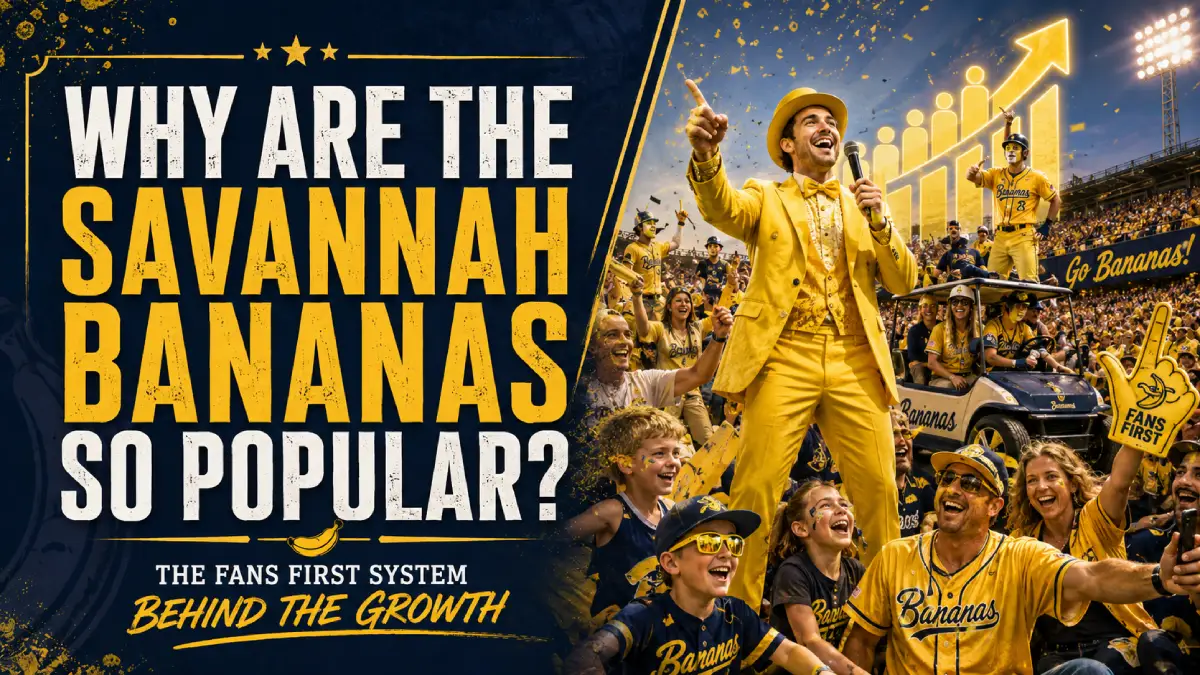
The Savannah Bananas are often described as a viral baseball team, but “they are popular because TikTok” is too shallow an explanation. Their growth came from a system: make the fan experience noticeably different, make players and characters memorable, remove long stretches of dead time, and build moments that travel well beyond the stadium.
The organization’s official history says it arrived in Savannah in October 2015 after minor league baseball had left the city. Early ticket sales were weak enough that owners Jesse and Emily Cole sold their home to keep the operation going. The team name was announced on February 25, 2016; the attention around it helped produce a sold-out Opening Night. That origin matters because the entertainment model was not added to an already dominant sports property. It was a response to the problem of getting people to care in the first place.
1. “Fans First” is an operating rule, not just a slogan
The official About Us page summarizes the approach as “Fans First” and “We Entertain Always.” That language shows up in the product decisions: dancing players, scoring celebrations, unusual characters and constant interaction are treated as part of the event rather than interruptions around the baseball.
The value of that approach is consistency. A fan who does not know the batting order can still understand whether the night was fun. A baseball fan can still follow competition. A child can remember a dancing umpire. A social-media viewer can recognize a player from a 15-second clip and later buy a ticket in another city.
2. The show has recognizable recurring characters
The Bananas built a cast around the game. Official team material highlights Jesse Cole’s yellow tuxedo, the Banana Nanas senior dance team, the Man-Nanas dad-bod cheerleaders, the Banana Splitz youth dancers, dancing umpire Vincent Chapman, breakdancing first-base coach Maceo Harrison, the Banana Baby tradition and Dakota “Stilts” Albritton.
That matters because recurring characters create memory. A generic between-innings promotion disappears when the game ends. A fan who knows “Stilts,” the Banana Nanas or the dancing umpire has a reason to recognize the next clip. Our separate Banana Ball entertainment guide explains those traditions without mixing them into the rules page.
3. Players are athletes and performers at the same time
The entertainment does not remove the baseball requirement. Players still have to hit, pitch, field and make decisions under a competitive scoring system, while also handling choreographed dances, walk-ups, celebrations and crowd-facing moments. That combination is a large part of the product’s appeal.
It also creates star pathways that conventional minor-league baseball rarely produces. Jackson Olson can be a Savannah Bananas infielder, a social-media personality and a “Dancing with the Stars” contestant. KJ Jackson can build an identity around hitting and trick plays. A fan can follow a player for baseball performance or for entertainment without the two being mutually exclusive.
4. Banana Ball is designed to create fewer dead moments
The sport’s rules change pace and incentives: a two-hour time limit, no stepping out, no bunting, fan-caught foul balls as outs, inning-based scoring and other variations make the game feel different from traditional baseball. The rules are not the entire reason for the Bananas’ popularity, but they support the entertainment model because the event is designed to keep moving.
For the actual rule set, use the Banana Ball Rules guide. This popularity article focuses on why the format attracts attention, not on reproducing the rulebook.
5. The content is built into the live product
The official team describes recurring “3-2-2” pre-pitch dances and elaborate walk-ups and celebrations. Those moments are not created after the fact by a social-media department searching for something to post. They happen inside the event, which means the live show continuously produces short visual stories that can travel online.
That is a major difference between “marketing a baseball game” and designing a baseball game that naturally produces marketing material. The social clip and the ticketed experience reinforce each other.
6. Scarcity and sellouts turned local demand into a national tour
The organization says it has sold out every game since its first season, from Grayson Stadium to NFL and MLB stadiums. As demand grew, the tour expanded into bigger and more varied venues. ESPN reported a 2026 plan spanning 75 stadiums and 45 states.
That national footprint changes the growth loop. Fans no longer need to travel to Savannah to understand the product. A local MLB or football stadium can become someone’s first Banana Ball experience, while Historic Grayson Stadium remains the origin point.
7. The Savannah identity was not abandoned during expansion
National growth can make a sports brand generic if every stop looks interchangeable. The Bananas still return to Historic Grayson Stadium, and the organization’s official history continues to frame Savannah as the place where the model was tested.
That gives the national tour a story with a beginning: a struggling new summer team, a controversial name, a sold-out opening night, years of experimentation and eventually a six-team professional league.
8. The six-team BBCL gives repeat fans more to care about
In 2026 the product is no longer only “the Savannah Bananas come to town.” The BBCL has six teams, standings, records, an Open, a regular-season race and a postseason. That adds sports stakes to a product that was already strong at entertainment.
A fan can now ask who has the best record, when the Party Animals play Savannah, whether Loco Beach can climb the table or how Texas’s Open win affects the postseason. Those questions are why Standings, Results and Championship matter alongside the show.
9. Mainstream media crossovers keep widening the audience
ABC and ESPN have carried 2026 Banana Ball coverage, while Jackson Olson’s move into “Dancing with the Stars” puts a current Bananas player in front of an entertainment audience that may never search for baseball statistics. Jackie Bradley Jr.’s full-time commitment to the Indianapolis Clowns creates the opposite crossover: a recognizable MLB name enters Banana Ball.
Those moves are useful because they widen discovery without requiring the sport to stop being itself.
What people often misunderstand about the Bananas’ popularity
- It is not only social media. The live event is deliberately designed to create shareable moments.
- It is not only comedy. Competitive baseball ability still supports the product.
- It is not only the Savannah Bananas anymore. The six-team BBCL has its own league-level stories.
- It is not a single gimmick. Rules, characters, service philosophy, scarcity, touring and media all reinforce one another.
The popularity story has a documented timeline
The official Savannah Bananas history is unusually useful because it shows the growth before the viral clips. The organization says it arrived in Savannah in October 2015 after minor-league baseball left the city, sold only a handful of tickets in the early months, overdrafted its bank account and saw Jesse and Emily Cole sell their home to keep the project alive. The “Savannah Bananas” name was announced on Feb. 25, 2016. Opening Night then sold out.
| Moment | Why it matters |
|---|---|
| 2015 arrival in Savannah | The challenge started as getting people to care about a new summer-collegiate team. |
| Feb. 25, 2016 name launch | A deliberately unusual identity created attention before the product was nationally famous. |
| 2016 Opening Night sellout | The live experience converted attention into demand. |
| Seven Coastal Plain League seasons | The Bananas built a baseball history before becoming a year-round Banana Ball operation. |
| 2022 year-round Banana Ball move | The entertainment format became the core product rather than a side attraction. |
| 2026 six-team BBCL | The model expanded from one famous team into a league structure. |
The live product creates the social content — not the other way around
It is easy to describe the Bananas as “a TikTok team,” but that reverses the mechanism. The official site lists recurring elements that are built into the event itself: choreographed player dances, a 3-2-2 pre-pitch dance, theatrical walk-ups, scoring celebrations, the Banana Nanas, Man-Nanas, Banana Splitz, a dancing umpire, a breakdancing first-base coach and the Banana Baby tradition.
Those are live-event ideas first. Cameras then turn them into short, understandable clips. A viewer does not need a box score or a 10-minute explanation to understand a player dancing before a pitch, a fan catching a foul ball for an out or a 10-foot-tall hitter stepping to the plate. The distribution advantage comes from designing moments that survive outside the stadium.
Why the system is difficult to copy
Another team can add music, a mascot race or a social-media manager. That does not automatically reproduce the Bananas’ result because the individual pieces reinforce each other:
- Rules reduce dead time. The baseball itself is designed to keep moving.
- Cast creates continuity. Fans recognize recurring performers and player personalities.
- Scarcity creates urgency. Sellouts and lotteries turn attendance into something fans plan for.
- Touring expands the funnel. People can experience the product without traveling to Savannah.
- Content brings new viewers back to the event. Viral discovery points toward tickets, streams, rosters and future games.
The important word is system. Popularity is not coming from one rule or one celebrity player.
Scale is now part of the evidence
By the 2026 expansion announcement, ESPN reported that Banana Ball had played in front of more than 2 million fans and sold out 17 MLB stadiums in 2025. The 2026 plan grew to 75 stadiums in 45 states, with an expected audience of about 3.2 million. Those numbers matter because they show that the audience was not confined to social feeds or a 4,000-seat home park.
At the same time, the official Bananas history still treats Historic Grayson Stadium as the origin point. That combination—national scale without erasing the original home—is part of why the brand feels larger without becoming anonymous.
The six-team league changes the kind of fandom Banana Ball can create
A single-team phenomenon can create celebrity fans. A league can create rivalries, standings arguments, favorite opponents and player loyalties that survive even when Savannah is not in the game. That is the long-term test of the BBCL: whether people begin following the Party Animals, Firefighters, Texas Tailgaters, Loco Beach Coconuts and Indianapolis Clowns for their own identities and results.
If that happens, the Bananas’ biggest achievement will not be producing viral baseball clips. It will be turning an entertainment formula into a repeatable sports league.
Why are the Savannah Bananas so popular? FAQ
Did the Savannah Bananas start as Banana Ball?
No. The organization began as a Savannah college summer team and later moved to year-round Banana Ball after leaving the Coastal Plain League.
When did the Savannah Bananas name start?
The official history says the name was announced February 25, 2016.
Is Banana Ball popularity mostly because of TikTok?
Short-form video helped expand reach, but the clips come from a live product intentionally built around entertainment, pace and fan interaction.
Are the Savannah Bananas the only Banana Ball team?
No. The 2026 BBCL has six teams. Use the Teams hub to compare them.
Related Banana Ball coverage
More stories, explainers and season analysis.
Why Banana Ball Is Playing MLB Stadiums in 2026 and What the Bigger Venues Mean
Banana Ball’s MLB-stadium stops are not just a schedule list. They show how a Savannah-born entertainment model is scaling into major markets while keeping smaller parks and Grayson Stadium in the tour.
Aug 21, 2026 · Reviewed Aug 21, 2026Read update →
Historic Grayson Stadium: The Place Where the Savannah Bananas Built Banana Ball
Historic Grayson Stadium is more than the Bananas’ home stop. It is where a struggling Savannah team tested the Fans First ideas that eventually grew into a national six-team league.
Aug 21, 2026 · Reviewed Aug 21, 2026Read update →
Jesse Cole’s Fans First Strategy: How the Yellow Tuxedo Became a Sports Business System
Jesse Cole’s yellow tuxedo is the visible symbol, but the deeper Banana Ball story is an operating system built around Fans First, entertainment, friction removal and constant experimentation.
Aug 21, 2026 · Reviewed Aug 21, 2026Read update →