
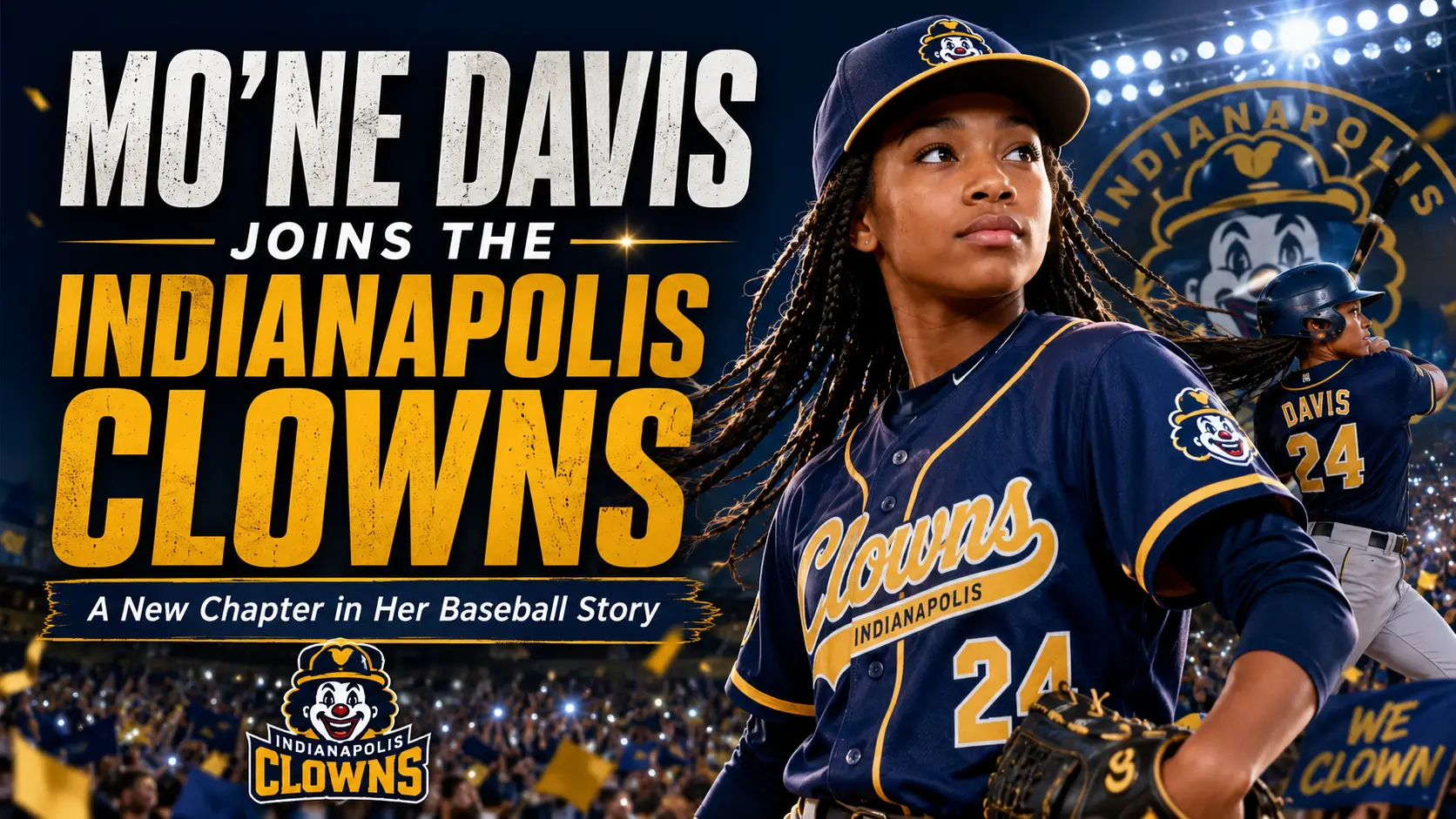
Mo’ne Davis became one of the most recognizable youth baseball players in the country in 2014. Twelve years later, her baseball story added a very different chapter: the Indianapolis Clowns announced Davis as part of their 2026 Banana Ball roster.
The Philadelphia Inquirer reported the signing in April, noting that Davis had also been a first-round selection in the inaugural Women’s Professional Baseball League draft. The combination makes her Banana Ball move more interesting than a nostalgia appearance. She is continuing to pursue baseball while entering a format that puts competition and entertainment on the same stage.
Who is Mo’ne Davis?
Davis became a national figure during the 2014 Little League World Series with Philadelphia’s Taney Dragons. The Inquirer notes that she became the first girl to win a game and pitch a shutout in Little League World Series history. Her performance made her one of the rare youth baseball players whose name remained recognizable well beyond the tournament.
That history matters, but Davis’s current story matters too. Her 2026 role deserves attention beyond the achievement that first made her famous.
What is her current Indianapolis Clowns role?
The current Indianapolis Clowns roster lists Mo’ne Davis as #29, RHP, from Philadelphia, Pennsylvania. That roster listing does not confirm a particular game-day pitching assignment.
Current performance numbers are best checked on her player profile or the Stats hub; the broader story is how her career led to the Clowns.
Why the Clowns are an unusually meaningful team for this story
The modern Indianapolis Clowns name deliberately reaches back to an important Negro Leagues franchise whose history included women breaking professional baseball barriers. The Negro Leagues Baseball Museum documents Toni Stone, Mamie “Peanut” Johnson and Connie Morgan as women who played for the historic Clowns in the 1950s.
That does not mean Davis’s modern signing is the same event or that the 2026 BBCL club is a simple uninterrupted continuation of the historic franchise. It does make the context worth explaining carefully. The Clowns name carries a history where women’s participation in professional baseball is already part of the story.
Davis is also part of a broader women’s baseball moment
The Inquirer reported that Davis had been selected in the first round of the Women’s Professional Baseball League draft before joining the Clowns. That gives her 2026 season two different baseball contexts: a new women’s professional league and Banana Ball’s entertainment-forward championship league.
Those paths should not be treated as interchangeable. The leagues have different formats and goals. What connects them is Davis choosing to keep playing baseball at a time when her public identity could easily have remained frozen around what she did as a 13-year-old.
Why Banana Ball makes sense as a crossover platform
Banana Ball has repeatedly used recognizable athletes and personalities to introduce new audiences to the sport, but the strongest crossovers still need a real roster role. Davis is listed as a pitcher, and the Clowns are a full BBCL team whose games affect the same results and standings system as the rest of the league.
That is more useful than framing her as a celebrity guest. Fans can follow the Clowns schedule, current standings and recent results without needing a separate “Mo’ne Davis schedule” page.
The modern Clowns roster has multiple crossover stories
Davis joins a team that also features Jackie Bradley Jr., the former MLB All-Star and World Series champion who committed full time to Banana Ball. Ryan Howard serves in the modern club’s prime-time coach role. Those names give Indianapolis a strong bridge to several baseball audiences without making the team dependent on one star.
Read our Jackie Bradley Jr. feature for the MLB-to-Banana-Ball angle and the Clowns history guide for the historic context behind the name.
What the current roster alone cannot confirm
Being on the roster does not prove Davis appeared in every Clowns game, started a specific matchup or produced a particular stat line. Those claims require player-level game data, not only team results.
A team result can provide useful context, but it cannot confirm that an individual player appeared in that game.
Her 2026 story now spans two different versions of professional baseball
Davis’s year did not stop with the Clowns signing. MLB noted that she had made an appearance for the Indianapolis Clowns while also preparing for the Women’s Professional Baseball League. By August, Philadelphia coverage described her competing in the WPBL after spending the summer with the Clowns.
That makes the story more interesting than “famous Little Leaguer tries Banana Ball.” Davis is moving between a conventional emerging women’s professional baseball league and a performance-driven BBCL team in the same year.
The 2014 achievement still matters because it changed who people imagined on a mound
Davis became a national figure at 13 after pitching for Philadelphia’s Taney Dragons in the Little League World Series. She became the first girl to earn a win and throw a shutout in LLWS history. That achievement is old enough to be background now, but it explains why her later choices continue to carry symbolic weight.
It also means articles should resist freezing her at age 13. Her current career includes Hampton softball, professional-baseball opportunities, the Clowns and the WPBL. A strong 2026 feature has to treat those as the main story rather than repeatedly retelling Williamsport.
The historic Clowns context adds meaning without creating a false equivalence
The Negro Leagues Baseball Museum documents Toni Stone, Mamie “Peanut” Johnson and Connie Morgan as women who played for the historic Indianapolis Clowns in the 1950s. MLB’s Toni Stone history notes that Stone joined the Clowns in 1953 and succeeded Hank Aaron at second base after he moved into organized baseball.
Davis joining a modern BBCL team is not the same historical event. The leagues, conditions and stakes are different. But the name carries a documented history of women competing on a men’s professional baseball roster, which makes the modern roster choice worth contextualizing rather than treating it as a novelty.
Why Banana Ball can be useful for a player with Davis’s profile
The format asks athletes to perform in front of large crowds, improvise, interact with fans and stay comfortable in a highly visible environment. Davis has spent much of her life under unusual public attention, from the LLWS to national media and now two professional baseball settings. Banana Ball turns that visibility into part of the on-field job.
At the same time, her presence gives the Clowns another audience bridge: youth baseball fans who remember 2014, women’s baseball followers, Philadelphia fans and people discovering the modern Clowns through Negro Leagues history.
What to follow next
- Her current Clowns roster status and verified Banana Ball appearances.
- How she balances BBCL commitments with the WPBL calendar.
- Whether her pitching role changes as the season progresses.
- How the modern Clowns continue to explain the history of women on the historic team.
For current performance numbers, use the player profile when verified stats are available. The broader career context explains what a box score cannot.
Davis is a bridge between audiences that rarely overlap
Her name can bring together people who remember the 2014 Little League World Series, fans following the new Women’s Professional Baseball League, viewers interested in the modern Clowns, and families encountering Banana Ball for the first time. Few players on a new roster arrive with that many separate entry points.
The important point is not to reduce Davis to a symbol. Her current baseball work—throwing, appearing with Indianapolis and competing in women’s professional baseball—deserves the same attention as the historical meaning attached to her name.
The current season gives the story an ending that is still being written
Davis’s 2026 role can still evolve. A major Clowns development, a significant WPBL milestone or a new first-party interview could add important context, while routine box-score changes are better followed through current player and stats pages.
Her 2026 workload also shows that “baseball career” no longer has one path
Davis can participate in Banana Ball and a new women’s professional league without either experience needing to invalidate the other. One emphasizes performance and crowd interaction; the other is building a conventional professional competition for women. Her season illustrates how modern players can move between baseball formats while still treating each one seriously.
Mo’ne Davis and Banana Ball FAQ
Does Mo’ne Davis play for the Indianapolis Clowns?
She is listed on the current 2026 Indianapolis Clowns roster as #29 and a right-handed pitcher.
Why is Mo’ne Davis famous?
She became a national baseball figure during the 2014 Little League World Series, where she made history as a pitcher for Philadelphia’s Taney Dragons.
Was Mo’ne Davis drafted by a women’s professional baseball league?
Yes. The Philadelphia Inquirer reported that she was a first-round pick in the inaugural Women’s Professional Baseball League draft.
Where can I see Indianapolis Clowns games?
Use the Indianapolis Clowns schedule for current dates, opponents and venues.
Related Banana Ball coverage
More stories, explainers and season analysis.
Jackson Olson Joins Dancing with the Stars Season 35: Why the Bananas Crossover Matters
Savannah Bananas infielder and social-media personality Jackson Olson is joining Dancing with the Stars Season 35. Here is the verified baseball background and why the crossover is a major Banana Ball story.
Aug 21, 2026 · Reviewed Aug 21, 2026Read update →
Why Jackie Bradley Jr.’s Full-Time Banana Ball Move Matters for the Indianapolis Clowns
Jackie Bradley Jr. became the first former MLB player to commit full time to Banana Ball when Indianapolis selected him No. 1 in the inaugural draft. The move changed the Clowns’ profile and the league’s MLB crossover.
Aug 21, 2026 · Reviewed Aug 21, 2026Read update →
Banana Bowl 2026: Savannah Bananas vs Texas Tailgaters — Preview & How to Watch
Savannah Bananas vs Texas Tailgaters: Banana Bowl 2026 game time, Disney livestream, six recent meetings, postseason performances and game-day details.
Oct 10, 2026 · Reviewed Oct 10, 2026Read update →