
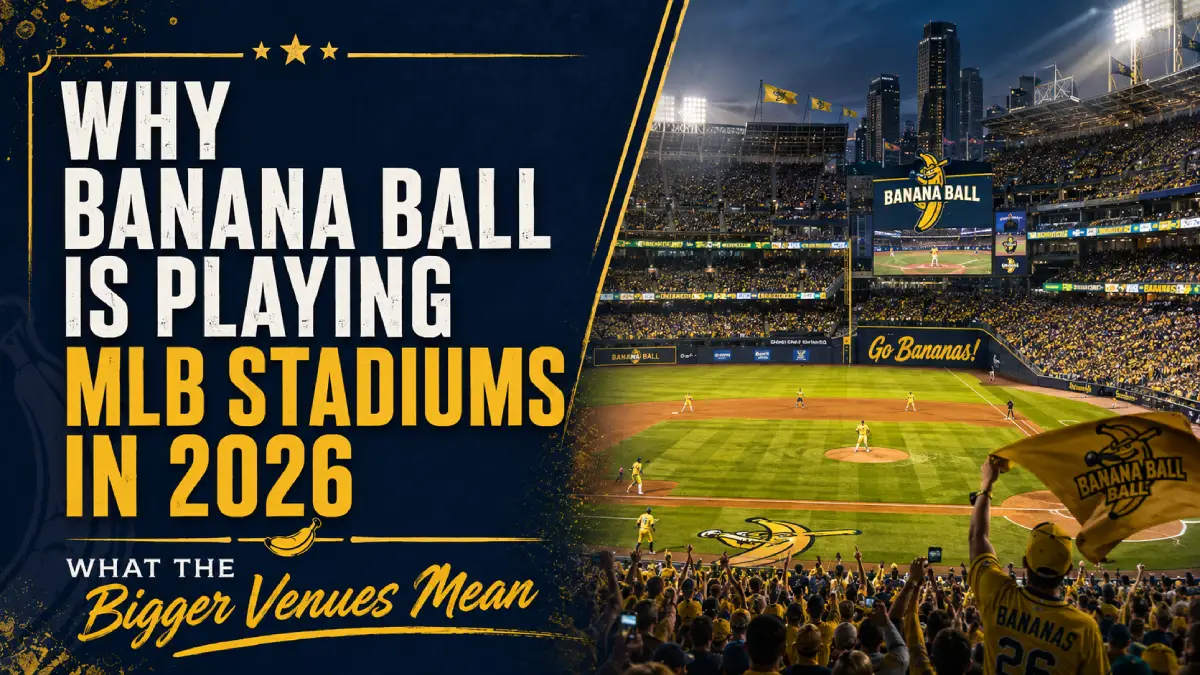
Yankee Stadium, Wrigley Field, Coors Field, Busch Stadium, Comerica Park, Globe Life Field and Progressive Field all appear on the published 2026 Banana Ball calendar. The easy article would be a list of those parks. The more useful question is why a sport that built its identity at Historic Grayson Stadium now needs major-league scale.
The answer is demand, geography and brand growth. ESPN reported a 2026 vision spanning 75 stadiums and 45 states. Large MLB parks let Banana Ball reach more people in major markets, but the same schedule still includes minor-league parks, college facilities, football venues and repeated Savannah weekends. The growth model is a mix, not a permanent move into one venue category.
The major-league stops on the 2026 schedule
The published calendar includes current MLB ballparks such as Yankee Stadium in New York, Wrigley Field in Chicago, Coors Field in Denver, Busch Stadium in St. Louis, Comerica Park in Detroit, Globe Life Field in Arlington and Progressive Field in Cleveland.
Keeping that distinction clear also helps fans: this feature explains the stadium trend, while the schedule carries the exact date, matchup, city and venue for each game.
MLB stadiums solve a capacity problem
The Savannah Bananas’ official history says the team has sold out every game since its first season. When interest outgrows a smaller park, adding more tour cities helps, but capacity still matters. MLB stadiums provide tens of thousands of seats in markets where a smaller venue could leave a large amount of demand unmet.
That does not guarantee every seat or every event sells the same way. It simply explains why a touring product with national demand would test larger buildings.
The contrast is part of the marketing
Banana Ball intentionally challenges traditional baseball expectations, which makes an iconic traditional venue an effective stage. A choreographed player dance at Wrigley or a fan-first spectacle at Yankee Stadium creates a visual contrast people understand instantly: familiar ballpark, unfamiliar baseball experience.
The same dynamic works at historic venues. The brand does not need to reject baseball tradition; it can use recognizable baseball spaces while changing the pacing, rules and presentation inside them.
Bigger venues also widen first-time discovery
A person who has never followed the Savannah Bananas may notice an event because it is happening at the home of a local MLB club. That creates a different discovery path from seeing a TikTok clip or hearing about Grayson Stadium.
For Banana Ball as a league, that matters even more in 2026 because not every major-venue game is simply “the Bananas versus somebody.” The six-team BBCL can place different teams and storylines in major markets.
Why the tour still needs smaller parks
Scale is only one part of the experience. Smaller parks can create denser crowd energy, closer sightlines and a different relationship between performers and fans. The 2026 schedule continues to use those venues because the product is portable.
That mix also helps geographic reach. Jesse Cole told ESPN that the goal was to play both the biggest and smallest stadiums so more people could reach a game within a reasonable drive. A national tour cannot accomplish that by using only MLB cities.
Historic Grayson Stadium remains strategically important
The schedule repeatedly returns to Savannah even as the tour expands. Grayson is not competitive with an MLB park on capacity; it serves a different purpose. It is the origin venue, a recurring home environment and part of the story that explains why the brand is distinctive.
Read the Grayson Stadium feature for that history rather than treating the stadium as just another row in a venue list.
What changes for fans at an MLB park
The Banana Ball rules may be the same, but the attendance logistics can be different. Parking, bag rules, gate procedures, accessibility routes and seating sections are controlled by the host venue. A fan should verify those details with the stadium rather than assume a Grayson Stadium routine applies everywhere.
For ticket-buying principles, use the Tickets guide. For the current broadcast assignment, use Where to Watch.
What the MLB-stadium strategy says about Banana Ball
The most important signal is that Banana Ball is trying to grow as a sports-and-entertainment product without waiting for a conventional baseball development path. It can add teams, expand television distribution, enter MLB stadiums and still preserve the fast, theatrical experience that made it distinct.
The 2026 expansion into six clubs reinforces that. Bigger venues are not just a Savannah Bananas victory lap; they are infrastructure for a league trying to create national relevance.
The 2026 venue plan is a scale experiment
ESPN’s launch coverage put hard numbers on the plan: 75 stadiums, 45 states, about 3.2 million expected fans, 14 MLB parks and 10 football stadiums. Two football venues—Texas A&M’s Kyle Field and Tennessee’s Neyland Stadium—were cited at capacities above 100,000, while Dehler Park in Billings was deliberately placed at the opposite end of the scale.
| Venue type | 2026 example | What it tests |
|---|---|---|
| MLB park | Yankee Stadium, Wrigley Field, Busch Stadium, Globe Life Field | Can Banana Ball carry a major-league-sized event atmosphere? |
| Football stadium | Kyle Field, Neyland Stadium, Gillette Stadium | Can the show scale beyond a baseball bowl and still feel coherent? |
| Minor-league / regional park | Dehler Park and other smaller stops | Can the tour preserve intimacy and geographic reach? |
| Historic home | Grayson Stadium | Can national growth keep a recognizable origin point? |
Why an MLB park changes more than the ticket count
A larger venue changes sightlines, pregame logistics, crowd movement, sound and how the entertainment reads from the upper deck. A bit that feels intimate at Grayson has to remain legible for tens of thousands of people. That makes stadium scale a production challenge as much as a demand story.
It also changes discovery. A fan who has never followed Banana Ball may understand “they are playing Yankee Stadium” or “they are at Wrigley Field” immediately. The venue itself becomes part of the headline, which gives the tour another way into mainstream sports conversation.
Some of the 2026 MLB-park dates
The published 2026 calendar includes major-league venues across the season rather than concentrating them in one promotional weekend. Among the headline stops are:
- Yankee Stadium in New York — Savannah Bananas vs Party Animals, April 25–26.
- Truist Park in Atlanta — Party Animals vs Savannah Bananas, May 8–10.
- Kauffman Stadium in Kansas City — Indianapolis Clowns vs Savannah Bananas, May 30–31.
- Wrigley Field in Chicago — Firefighters vs Savannah Bananas, July 24–26.
- Coors Field in Denver — Savannah Bananas vs Indianapolis Clowns, Aug. 14–15.
- Busch Stadium in St. Louis — Savannah Bananas vs Loco Beach Coconuts, Aug. 21–22.
- Comerica Park in Detroit — Party Animals vs Firefighters, Sept. 18–19.
- Globe Life Field in Arlington — Savannah Bananas vs Texas Tailgaters, Sept. 25–27.
Use the live schedule for the complete calendar and any time or broadcast change. The point here is the pattern: MLB venues are distributed across different teams and different stages of the season.
The tour is deliberately not “biggest stadium wins”
One of the smartest parts of the 2026 announcement is that it paired enormous venues with a 3,000-seat Billings stop. Jesse Cole told ESPN the goal was broad geographic access, not simply maximizing capacity every night. That means the venue strategy is serving two objectives at once: spectacle and reach.
The national-stadium story explains the scale of the tour, while individual game listings remain the best place to confirm the exact city, venue, date and local start time for a specific matchup.
What would prove the MLB-stadium strategy worked?
Sellouts are one signal, but the stronger test is whether the league can turn one-time stadium curiosity into repeat team interest. If a first-time Wrigley or Busch Stadium visitor later checks the standings, follows a player or watches a non-Savannah matchup, the large venue has done more than create a big photo.
Broadcast scale and venue scale are reinforcing each other
The stadium strategy does not sit separately from media growth. ESPN’s 2026 package includes games at Yankee Stadium, Wrigley Field, Busch Stadium, Coors Field, football venues and other large settings. The first ABC national telecast came from Autzen Stadium, and ESPN later reported that the June 28 game averaged 1.2 million viewers—the largest Banana Ball television audience to that point.
That combination matters because the visual of a packed major venue helps television sell the event as more than a novelty, while national television gives the stadium stop an audience far beyond the seats. Physical scale and media scale are feeding the same growth loop.
The harder question is what happens after the spectacle
The bigger question is what happens after the spectacle. Does a first-time viewer remember only “Banana Ball played Wrigley,” or do they also learn that the Firefighters were playing Savannah, that both teams have records, and that the result feeds a championship season? The 2026 BBCL succeeds at scale only if the venue introduces the competition rather than replacing it.
Banana Ball MLB stadium FAQ
Does Banana Ball play in MLB stadiums in 2026?
Yes. Multiple current MLB ballparks are listed on the official 2026 schedule.
Does every MLB-stadium game feature Savannah?
No. The BBCL has six teams, so always confirm the matchup on the live Schedule.
Are MLB parks replacing Grayson Stadium?
No. The published schedule still includes repeated Savannah dates at Historic Grayson Stadium.
Where should I verify entry and parking rules?
Use the hosting stadium’s official information for event logistics, because those policies can differ by venue.
Related Banana Ball coverage
More stories, explainers and season analysis.
Why Are the Savannah Bananas So Popular? The Fans First System Behind the Growth
The Savannah Bananas did not grow on one viral clip. Their popularity combines a Fans First operating model, short-form entertainment, distinctive characters, baseball credibility and a national touring strategy.
Aug 21, 2026 · Reviewed Aug 21, 2026Read update →
Historic Grayson Stadium: The Place Where the Savannah Bananas Built Banana Ball
Historic Grayson Stadium is more than the Bananas’ home stop. It is where a struggling Savannah team tested the Fans First ideas that eventually grew into a national six-team league.
Aug 21, 2026 · Reviewed Aug 21, 2026Read update →
Jesse Cole’s Fans First Strategy: How the Yellow Tuxedo Became a Sports Business System
Jesse Cole’s yellow tuxedo is the visible symbol, but the deeper Banana Ball story is an operating system built around Fans First, entertainment, friction removal and constant experimentation.
Aug 21, 2026 · Reviewed Aug 21, 2026Read update →