
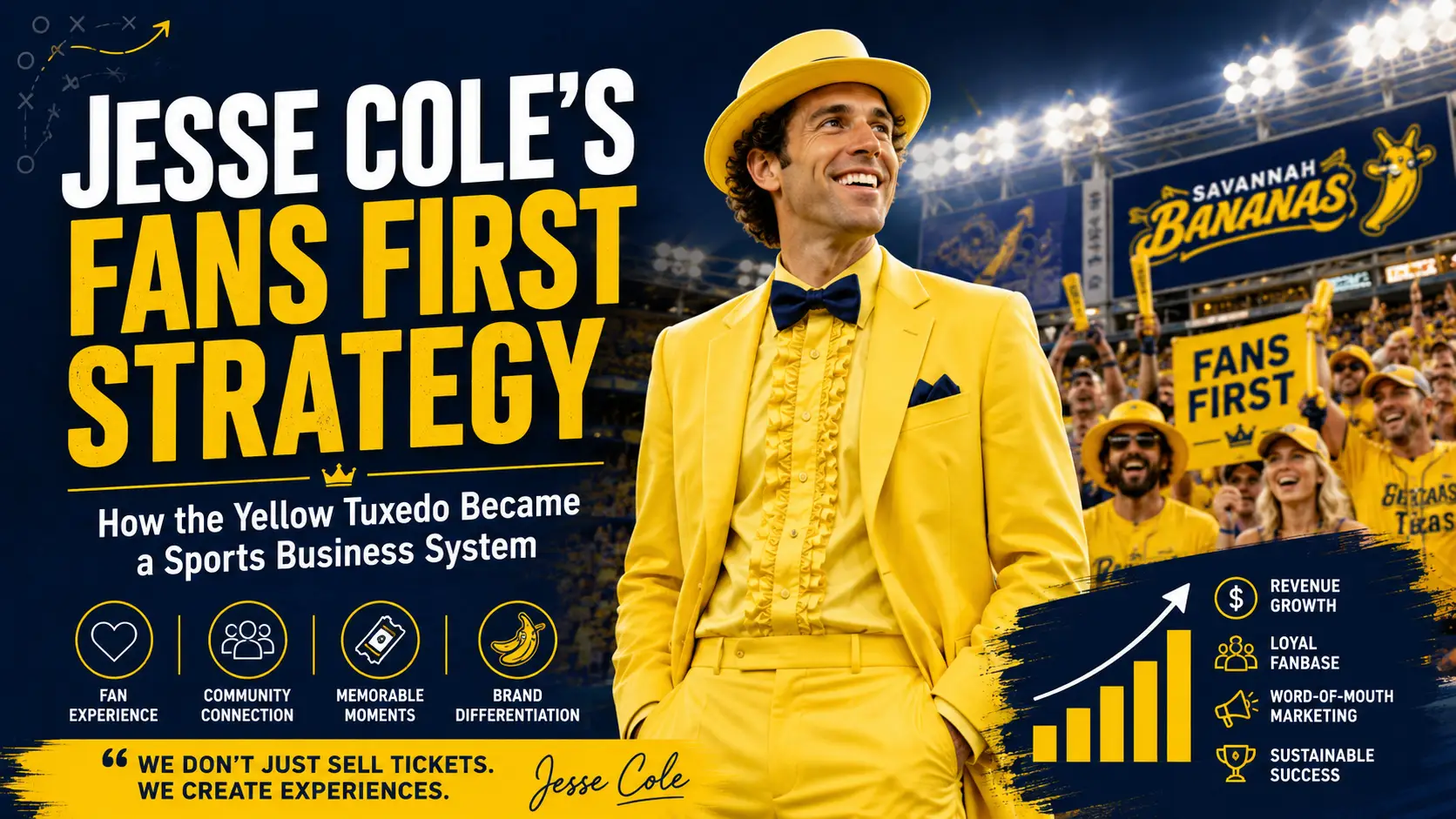
Jesse Cole’s yellow tuxedo is one of the easiest things to recognize about the Savannah Bananas. It is also the least useful way to explain why the organization grew. The deeper story is an operating philosophy the Bananas call Fans First: design the event around what creates value and memory for the fan, remove friction that weakens the experience, and keep testing ideas that make the product impossible to confuse with ordinary baseball.
The official Savannah Bananas history makes clear that this strategy developed under pressure. The organization arrived in Savannah in 2015 after minor-league baseball left the city. Early ticket sales were poor; Jesse and Emily Cole sold their home while trying to keep the new summer team alive. The eventual success was not the result of inheriting a full stadium.
The yellow tuxedo works because it is consistent
The team’s official site says Jesse Cole wears the yellow tuxedo all the time. A costume can be a gimmick once; repeated for years, it becomes a visual signature. Fans can identify the owner instantly in a crowd, on television or in a clip without reading a caption.
That is a small example of a larger branding principle: Banana Ball repeatedly chooses things that are easy to remember and hard to confuse with a conventional baseball organization.
Fans First starts with the experience, not the promotion
The Bananas do not simply advertise “fun baseball.” The product includes dancing players, unusual walk-ups, scoring celebrations, character acts and crowd interaction. Official team material also highlights the Banana Nanas, Man-Nanas, Banana Splitz, a dancing umpire, a breakdancing first-base coach and the Banana Baby tradition.
If the entertainment existed only in marketing, repeat attendance would expose the gap. By building those elements into the night itself, the organization turns the event into the source of the marketing.
Banana Ball rules support the same strategy
The two-hour time limit and other rule changes are often discussed as baseball novelties, but they also solve an experience problem: long dead periods make it harder to keep a casual fan engaged. Faster pacing and unusual scoring create more frequent moments that are easy to understand emotionally even when the viewer does not know every baseball convention.
That is why the rules and entertainment are connected without being the same thing. The rules shape pace; the characters and performances shape presentation.
The organization turned constraints into differentiation
Grayson Stadium was not the newest or largest venue. The original team was not an MLB affiliate. The roster did not come with household names. Those limitations forced the product to compete on experience instead of relying on inherited status.
That origin still matters now that Banana Ball can fill much larger buildings. The Grayson Stadium story is valuable because it shows what the model looked like before national scale.
Why “Fans First” is different from “the customer is always right”
The Bananas’ version is not simply agreeing with every request. It is designing the system around the fan’s time, attention and memory. A faster game, clear ticket process, recurring characters and a recognizable show can all serve that goal even if no individual fan requested the specific idea.
Jesse Cole’s official Fans First book description frames the approach as a way to stand out, inspire loyalty and produce unconventional results. The sports version of that idea is visible in the product itself.
Scaling from one team to six tests the philosophy
A Fans First model is easier to control with one home team. The 2026 BBCL has six clubs, dozens of venues, simultaneous series and new fan bases. That creates a harder challenge: can each team feel distinctive while the league maintains a recognizable Banana Ball standard?
The 2026 expansion is therefore not just a growth milestone. It is an operational test of whether the underlying model scales beyond the Savannah Bananas.
Why the system creates strong social content
Short-form platforms reward clear visual moments. Banana Ball produces them naturally: dances, catches, celebrations, costumes and fan interactions can be understood with little context. The organization does not have to manufacture a separate content universe after the game.
This is the key difference between “a sports team that uses social media well” and “a sports product designed to generate social-media moments.”
What other sports businesses can learn without copying the costumes
Copying a yellow tuxedo, a dance team or a two-hour rule would not reproduce Banana Ball. The transferable ideas are more general:
- make the experience easy to describe;
- remove recurring fan frustrations;
- create repeatable signature moments;
- let employees and players have recognizable identities;
- test ideas in the live product rather than only in advertising;
- keep the brand promise consistent as the operation scales.
The origin story explains why “Fans First” became an operating constraint
The official Bananas history says the organization arrived in Savannah in 2015, struggled to sell tickets, overdrafted its bank account and saw Jesse and Emily Cole sell their home to keep the project alive. That context matters. “Fans First” was not invented after a successful team needed a marketing slogan; it developed while the business was trying to make a new summer-collegiate team worth attending.
The team-name launch in February 2016 created attention, but Opening Night had to turn that attention into an experience. The official history says that first sellout already featured all-inclusive food, the Banana Nanas, the Banana Baby and dancing players. Many of the things later associated with the national brand were present before the scale arrived.
The strategy can be reduced to a repeatable flywheel
| Step | What Banana Ball does | Why it compounds |
|---|---|---|
| Remove friction | Design rules and event operations around pace and fan experience. | More of the night feels intentional rather than like waiting. |
| Create memorable moments | Dances, characters, walk-ups, trick plays and crowd participation. | Fans leave with specific stories instead of a generic game memory. |
| Make the moments shareable | Build visual ideas that can be understood in a short clip. | The live show creates its own marketing material. |
| Convert attention into scarcity | Tour nationally while demand exceeds available seats. | Future dates feel valuable before the game begins. |
| Reinvest in the experience | Keep adding performers, teams, venues and competitive structure. | The product has to improve as the audience gets larger. |
Why the yellow tuxedo matters less than the consistency behind it
A yellow tuxedo is easy to copy. The harder part is showing up with the same recognizable identity across years of games, interviews, tours and business decisions. Jesse Cole’s clothing works as a symbol because it is attached to a consistent point of view: normal sports assumptions are negotiable if changing them creates a better fan experience.
The organization even sells a Fans First book built around the business philosophy. The value of that idea is not that every company should dress like Cole; it is that the customer experience is treated as a design problem rather than a final marketing layer.
2026 is the hardest test of the philosophy so far
A one-team operation can keep culture centralized. A six-team league playing 75 stadiums across 45 states cannot rely on Jesse Cole physically controlling every fan interaction. ESPN’s 2026 expansion report shows how large the operating challenge became: millions of expected fans, new teams, prime-time coaches, huge football stadiums and a formal championship season.
If Fans First is really a system, it has to survive that decentralization. The Coconuts and Clowns need distinct identities while still feeling like part of the same product. A small Billings park and a 100,000-seat football stadium need to deliver the same core promise through very different environments.
What businesses can learn without copying the gimmicks
- Start with the frustrating parts of the customer journey. Fix the wait, confusion or friction before adding spectacle.
- Give people moments worth retelling. Memory is a stronger differentiator than a generic “premium experience.”
- Make the product create the marketing. The best Banana Ball clips are evidence of the event, not ads pretending to be entertainment.
- Protect the identity while scaling. Growth becomes dangerous when the thing people loved is diluted by capacity.
- Measure repeat behavior, not only attention. Viral reach matters more when it converts into viewers, ticket demand and team loyalty.
Fans First becomes more credible when it produces trade-offs
A philosophy is easy to advertise when it costs nothing. The Bananas’ story is more interesting when the organization chooses experience over familiar sports conventions: changing rules for pace, filling dead time with performance, taking games to nontraditional venues and keeping recurring cast members central to the night. Each choice creates operational complexity, which is evidence that “Fans First” is shaping the product rather than simply decorating it.
Fans First as a practical test
The same principle works for fans following the sport: make the score, date, ticket status or viewing information easy to find, then add the deeper story for readers who want context. That clarity fits the Fans First idea better than adding friction around a simple question.
Jesse Cole and Fans First FAQ
Who is Jesse Cole?
He is the owner and central public figure behind the Savannah Bananas and Fans First Entertainment, widely recognized for wearing a yellow tuxedo.
When did the Bananas arrive in Savannah?
The official history says the organization arrived in October 2015 and announced the Savannah Bananas name in February 2016.
What does Fans First mean?
It is the organization’s operating philosophy of designing the sports experience around fan value, entertainment and memorable service.
Is Fans First the same as Banana Ball rules?
No. Fans First is the broader operating philosophy; Banana Ball is the sport and rule format developed within that philosophy.
Related Banana Ball coverage
More stories, explainers and season analysis.
Why Are the Savannah Bananas So Popular? The Fans First System Behind the Growth
The Savannah Bananas did not grow on one viral clip. Their popularity combines a Fans First operating model, short-form entertainment, distinctive characters, baseball credibility and a national touring strategy.
Aug 21, 2026 · Reviewed Aug 21, 2026Read update →
Why Banana Ball Is Playing MLB Stadiums in 2026 and What the Bigger Venues Mean
Banana Ball’s MLB-stadium stops are not just a schedule list. They show how a Savannah-born entertainment model is scaling into major markets while keeping smaller parks and Grayson Stadium in the tour.
Aug 21, 2026 · Reviewed Aug 21, 2026Read update →
Historic Grayson Stadium: The Place Where the Savannah Bananas Built Banana Ball
Historic Grayson Stadium is more than the Bananas’ home stop. It is where a struggling Savannah team tested the Fans First ideas that eventually grew into a national six-team league.
Aug 21, 2026 · Reviewed Aug 21, 2026Read update →