
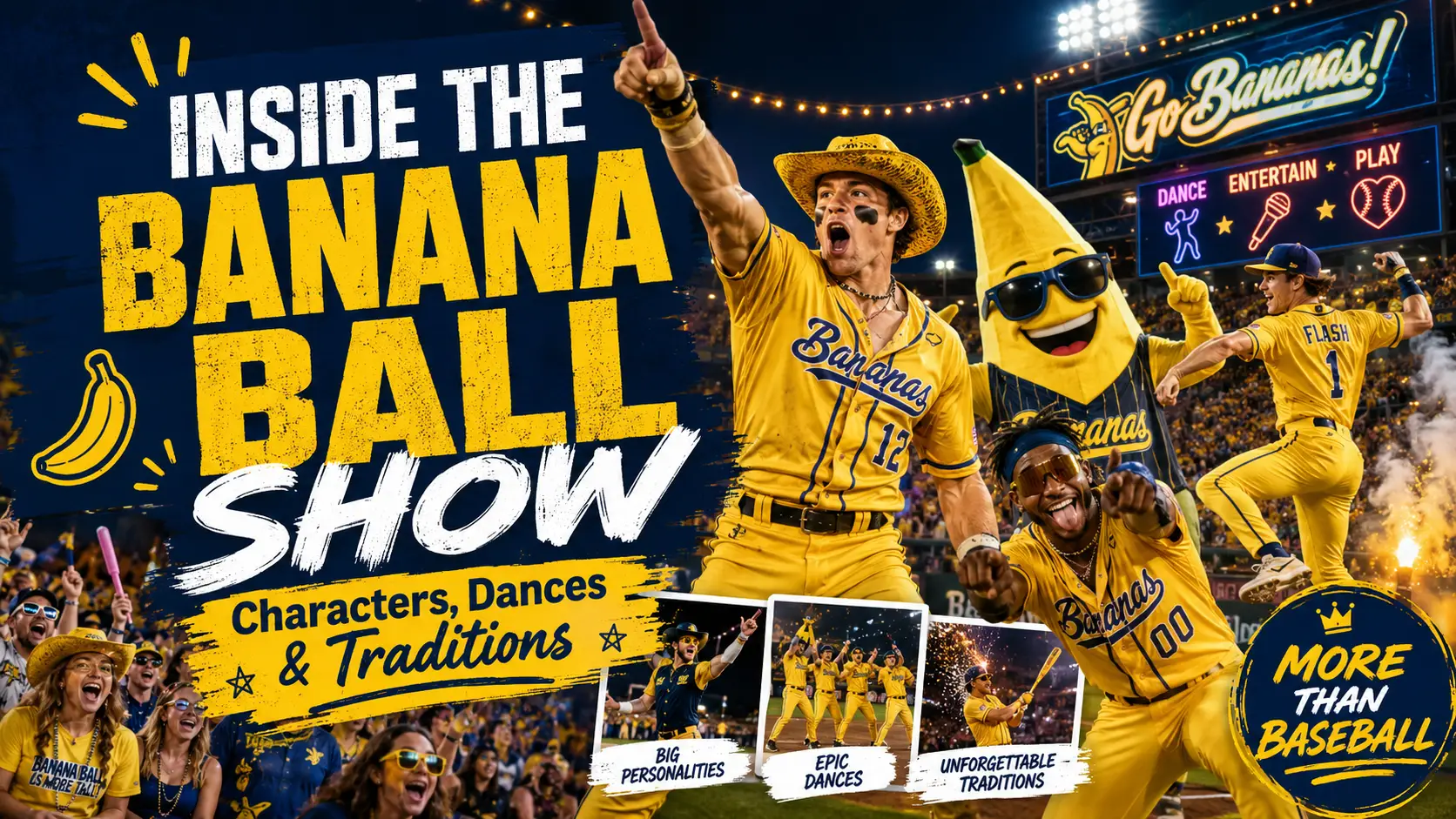
A first-time viewer can learn all 11 Banana Ball rules and still be surprised by the live event. That is because the rulebook explains how the game works, not why a strikeout might trigger a dance, why a baby in a banana costume appears, or why the first-base coach may start breakdancing.
The Savannah Bananas’ official About Us page describes a recurring cast and a set of traditions that make the show recognizable. These entertainment traditions sit alongside the rules, but they are not scoring rules themselves.
Jesse Cole and the yellow tuxedo
Owner Jesse Cole’s yellow tuxedo is the most visible recurring costume in Banana Ball. It functions like a character uniform: even a first-time viewer can identify the person driving the show. The consistency turns an unusual outfit into a brand marker.
The Banana Nanas
The Banana Nanas are the organization’s senior-citizen dance team. They have been part of the Savannah experience since the early years and are one of the clearest examples of the Fans First idea: entertainment does not have to look like conventional baseball promotion or target only a young demographic.
The Man-Nanas
The Man-Nanas are described by the team as a “Dad Bod Cheerleading Squad.” Like the Banana Nanas, the concept works because it is easy to explain and easy to recognize. It gives the crowd a recurring act rather than a one-off contest that disappears after the inning.
The Banana Splitz
The Banana Splitz are a youth dance team, adding another generation to the performance cast. Together, the Nanas, Man-Nanas and Splitz make the event feel more like a recurring ensemble show than a baseball game with random timeout entertainment.
Vincent Chapman, the dancing umpire
The official team site calls Vincent Chapman the world’s only dancing umpire and highlights his strike-three celebrations. The role is intentionally strange because umpires are normally expected to disappear into the background. Banana Ball turns that expectation into another entertainment opportunity.
The important distinction: the dance is presentation. Umpiring decisions still belong to the competitive game.
Maceo Harrison, the breakdancing first-base coach
Maceo Harrison is presented by the Bananas as a breakdancing first-base coach. That combination summarizes the format neatly: a legitimate baseball role and an entertainment role exist in the same person.
It is also one reason player and staff identity matters so much in Banana Ball. Fans are encouraged to recognize people who would be anonymous support staff in many other baseball settings.
The Banana Baby tradition
At each game, the organization says it honors a “Banana Baby,” with players and music turning a baby in a banana costume into a crowd moment. There is no competitive importance to it. Its value is ritual: regular fans know what is coming, while first-time fans immediately understand that the event is comfortable being ridiculous.
Dakota “Stilts” Albritton
Dakota Albritton is listed on the current Savannah roster and is known for performing on stilts, with the official site describing him as the world’s tallest hitter and pitcher at 10 feet tall when on stilts. He is a useful example of why Banana Ball player roles can look unusual in roster coverage.
Our player and roster pages preserve the team’s listed position labels rather than forcing every entertainer into a conventional baseball taxonomy.
The 3-2-2 dance
The Bananas describe a “3-2-2” moment — third inning, second batter, second pitch — as a recurring pre-pitch dance. It is designed to be anticipated by the crowd and clipped for social media, turning a specific point in the game into a signature beat.
Again, this is not a scoring rule. It is part of the show surrounding the competition, while the rules explain how the game itself is scored and played.
Walk-ups and scoring celebrations
Player entrances and scoring celebrations are another major layer. The team’s official material describes walk-ups that can involve elaborate entrances and scoring moments that send players through the crowd or into choreography.
These moments give individual players recognizable performance identities that can matter to fans beyond ordinary baseball statistics.
Why these traditions matter strategically
Recurring entertainment does three jobs at once:
- Live value: there is something for casual fans between competitive moments.
- Character building: staff and players become recognizable personalities.
- Content creation: short, visual moments are naturally shareable online.
That combination is a major reason a live Banana Ball event feels different even before a fan understands inning scoring or the Golden Batter.
What is not a Banana Ball rule
The Banana Nanas, yellow tuxedo, dancing umpire, Banana Baby and player choreography are traditions or performance elements. They are not part of the formal competitive rule set. If you want to know how outs, time limits, scoring, Showdown or Golden Batter work, use the Rules hub.
The entertainment system has several different layers
One reason Banana Ball can look chaotic from a short clip is that several kinds of performance are happening at once. The official Savannah Bananas site makes the structure easier to see.
| Layer | Examples | Role in the show |
|---|---|---|
| Recurring cast | Banana Nanas, Man-Nanas, Banana Splitz, dancing umpire, Maceo Harrison | Gives repeat fans recognizable characters. |
| Player performance | 3-2-2 dances, walk-ups, scoring celebrations | Makes athletes part of the entertainment instead of separating the show from the game. |
| Visual novelty | Dakota “Stilts” Albritton, costumes, theatrical entrances | Creates moments that are instantly understandable from the stands or a short clip. |
| Audience ritual | Banana Baby and crowd participation | Makes fans feel like part of the event rather than passive spectators. |
| Competitive spectacle | Trick plays and unusual rules | Connects entertainment back to real game consequences. |
The 3-2-2 is a good example of repeatable content design
The official Bananas site describes the 3-2-2 as a third-inning, second-batter, second-pitch dance. That specificity is important. It is not “players sometimes dance.” It is a repeatable cue that fans can anticipate, performers can prepare and social clips can package consistently.
Recurring formats are valuable because they create familiarity without requiring the exact same joke every night. Fans know when something is coming while still wondering what the performance will be.
Characters turn a touring event into a recognizable world
The Banana Nanas, Man-Nanas, Banana Splitz, dancing umpire Vincent Chapman and breakdancing first-base coach Maceo Harrison are not interchangeable halftime acts. They recur often enough to become part of the product’s vocabulary. A first-time fan sees spectacle; a repeat fan recognizes cast members.
That distinction matters as the league expands. A national tour can become anonymous if every stadium feels like a one-off roadshow. Recurring personalities create continuity even when the venue, opponent and city change.
Player entertainment works because the athletes stay inside the story
Many sports events outsource entertainment to a mascot or a timeout act. Banana Ball asks players themselves to participate in choreographed dances, theatrical walk-ups and scoring celebrations. That makes the star system different: a player can become memorable for baseball skill, a trick play, a recurring bit and a social personality at the same time.
Jackson Olson’s move into Dancing with the Stars is a useful example of how portable that identity can become. Jackie Bradley Jr.’s full-time move to the Clowns shows the opposite path: a familiar baseball name entering a format where performance is part of the job.
Why the show does not replace the competition
The strongest version of Banana Ball works when the entertainment creates attention and the competitive layer creates reasons to return. In 2026, standings, an Open berth, a regular season and a championship race give fans something to follow after the dancing clip ends.
That is also why the distinction between rules and traditions matters. A Banana Baby ceremony is memorable, but it does not change the score. A trick-play equalizer can. Good coverage should know the difference.
What makes a Banana Ball tradition durable?
- It is easy for a first-time fan to understand.
- It is visual enough to work in a large venue.
- It can vary without losing its identity.
- Players or fans are active participants rather than passive background.
- It fits the broader “Fans First” promise instead of feeling like an unrelated commercial break.
That framework is more useful than simply collecting a long list of funny moments. It explains why some bits become part of Banana Ball culture while others remain one-night jokes.
Why a list of funny moments is not enough
A long list of fan-game names can still miss the deeper reason the entertainment works. Recurring characters create familiarity, scheduled cues such as the 3-2-2 create anticipation, player participation keeps the show connected to the athletes, and crowd rituals make spectators part of the production.
Individual games and jokes can change from tour to tour, but the system behind them helps explain why new bits can be introduced without making the night feel random.
How the six-team era complicates the entertainment model
The BBCL cannot rely on every team simply copying the Savannah Bananas cast. The strongest league version will let the Party Animals, Firefighters, Tailgaters, Coconuts and Clowns build their own recurring identities while preserving a shared expectation that the event stays active and fan-facing. That is a harder creative task than scaling one set of characters nationally.
Banana Ball entertainment FAQ
Who are the Banana Nanas?
They are the Savannah Bananas’ senior-citizen dance team.
Who is the dancing umpire?
The official Bananas site identifies Vincent Chapman as its dancing umpire.
Who is the breakdancing first-base coach?
Maceo Harrison.
Is the Banana Baby part of the scoring rules?
No. It is an entertainment tradition at the live event.
Where can I learn the actual Banana Ball rules?
Use the Banana Ball Rules page for the competition format.
Related Banana Ball coverage
More stories, explainers and season analysis.
Banana Bowl 2026: Savannah Bananas vs Texas Tailgaters — Preview & How to Watch
Savannah Bananas vs Texas Tailgaters: Banana Bowl 2026 game time, Disney livestream, six recent meetings, postseason performances and game-day details.
Oct 10, 2026 · Reviewed Oct 10, 2026Read update →
Banana Ball Expansion in 2026: How the Coconuts and Clowns Changed the BBCL
The 2026 additions of the Loco Beach Coconuts and Indianapolis Clowns turned Banana Ball into a six-team championship league. Here is what changed in competition, scheduling, rosters and fan coverage.
Aug 21, 2026 · Reviewed Aug 21, 2026Read update →
Why Are the Savannah Bananas So Popular? The Fans First System Behind the Growth
The Savannah Bananas did not grow on one viral clip. Their popularity combines a Fans First operating model, short-form entertainment, distinctive characters, baseball credibility and a national touring strategy.
Aug 21, 2026 · Reviewed Aug 21, 2026Read update →